There’s a version of telehealth in a mobile clinic that doesn’t work: a tablet on a shelf, a hotspot in the console, and a hope that the connection holds. Most programs try that version first.
There’s another version that changes what a single unit can do — where one nurse practitioner and a community health worker on board can connect a patient to a cardiologist, an endocrinologist, or a psychiatrist who is two hundred miles away, and that specialist can actually see, hear, and use the diagnostic data being captured in the room.
The difference between those two versions is almost entirely a design decision, and it gets made before the unit is built.
Why the pairing is unusually strong
Telehealth alone has a well-documented limitation in exactly the communities that need it most: it presumes the patient has a device, sufficient bandwidth, privacy, and the comfort to use them. In rural and low-income areas, those assumptions fail often — which is why virtual care has sometimes widened the access gap it was supposed to close.
A mobile clinic solves every one of those. The unit brings the connectivity, the equipment, the private space, and — critically — a clinical staff member physically present with the patient.
That last piece is what makes the model clinically meaningful rather than just convenient. A remote specialist working with a trained person on-site can direct an exam, review a real-time ultrasound, listen through a digital stethoscope, examine a retinal image, and interpret point-of-care labs drawn minutes earlier. That’s a substantially different encounter than a patient alone with a phone camera. It’s the same logic behind our mobile remote medicine clinics, which are built for communities where the nearest specialist is hours away.
The staffing implication follows directly: your on-board team doesn’t need to include every specialty you want to offer. It needs to include people who can facilitate a specialist encounter well. One unit becomes a distributed front door to your entire medical group.
Where policy stands
Reimbursement uncertainty has been the biggest brake on telehealth investment, and it eased meaningfully this year.
The Consolidated Appropriations Act of 2026, signed in February 2026, extends Medicare telehealth flexibilities through December 31, 2027. Through that date, Medicare patients may continue receiving telehealth services from any location in the United States — including their homes — regardless of rural status or originating site restrictions.
Some provisions are permanent rather than temporary. Federal law permanently designated FQHCs and RHCs as distant-site providers for behavioral telehealth, letting clinicians based in those settings be reimbursed for virtual behavioral health care to Medicare beneficiaries regardless of patient location. And per HHS telehealth policy guidance, the in-person visit requirement within six months of an initial Medicare behavioral or mental telehealth service — and annually thereafter — is waived through December 31, 2027.
The honest caveat: many key flexibilities remain temporary. As KFF notes, there is bipartisan support for permanently expanding Medicare telehealth coverage, but questions remain about long-term impact on care, spending, and program integrity — and stakeholders continue pushing for stand-alone legislation to reduce dependence on short-term funding bills.
Practical read: you have roughly a year of relative clarity ahead, with behavioral health on the firmest footing. Behavioral telehealth is the safest place to anchor a program that has to justify itself on reimbursement — and it’s the service line where the permanent provisions actually hold.
What to build into the unit
Retrofitting connectivity and clinical technology into an existing vehicle is expensive and usually compromised. These are the specifications worth getting right at build.
Connectivity, with redundancy
A single carrier will fail somewhere on your route. Assume it. A serious build includes multi-carrier cellular bonding, satellite as a fallback for genuinely remote deployments, and roof-mounted external antennas rather than reliance on an interior hotspot fighting a metal shell.
Bonding matters more than raw speed. A video consult degrades gracefully with modest bandwidth but fails hard with packet loss and jitter — which is exactly what you get from a single marginal connection. Spec for headroom: simultaneous video consult, EHR sync, and diagnostic image transfer at the same time, not sequentially.
Power that doesn’t die mid-consult
Nothing damages a program’s credibility faster than dropping a specialist call because the inverter cut out. Battery capacity sized for a full clinical day without shore power, clean power conditioning for imaging and diagnostic equipment, and quiet operation — a generator loud enough to interfere with an audio consult is a clinical problem, not just a comfort one.
A space that reads as private
Behavioral health, sexual health, substance use — the highest-value telehealth service lines are the ones with the highest privacy sensitivity. If the consult area is a corner of an open bay with a curtain, patients will not disclose.
That means a genuinely enclosed consult space, acoustic treatment on shared walls, camera framing that doesn’t put the waiting area in the background, and a door. This is the single most commonly underspecified element, and the most consequential.
Peripherals that make the remote clinician useful
The equipment set depends on your service lines, but the common ones: digital stethoscope, handheld ultrasound, otoscope and dermatoscope with camera, retinal camera for diabetic eye screening, point-of-care lab analyzers, and a pan-tilt-zoom exam camera the remote clinician can control themselves rather than directing your staff by voice.
Mounting and ergonomics
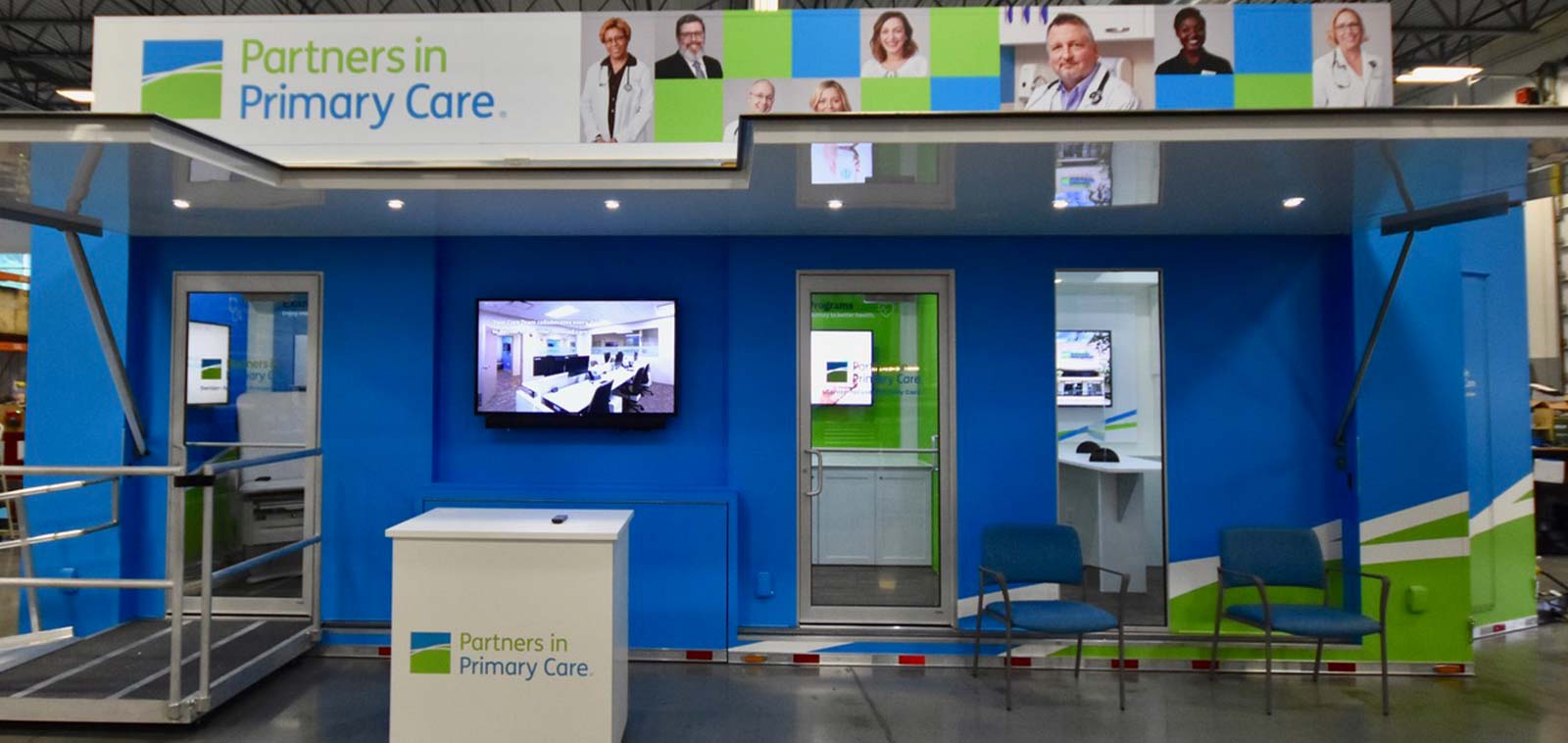
Screens at seated eye level, positioned so the patient can see the specialist and the on-site clinician simultaneously. Lighting that doesn’t backlight faces. Everything secured for transit. Cable management that survives a year of daily use.
What gets underestimated
Staff training. Facilitating a telehealth encounter is a learned skill. Your team needs to know how to position a patient for a remote exam, operate peripherals to the specialist’s direction, and manage the social awkwardness of a three-way encounter. Budget training time, not just equipment.
Scheduling coordination. The unit runs a route. Specialists have their own schedules. Making those intersect reliably is an operations problem that eats more time than the technology does — and it’s the most common reason well-equipped programs underuse their telehealth capability.
Documentation and integration. If the remote encounter lands in a different system than the on-site encounter, you’ve created a fragmented record and a billing headache. Sort out how the visit documents into your EHR before the first deployment.
A degraded-mode plan. Connectivity will fail at some point. Know in advance what happens: reschedule, audio-only fallback, or store-and-forward. A documented plan turns an outage into an inconvenience instead of a lost patient.
The design principle underneath all of it
Telehealth capability isn’t an accessory you add to a mobile clinic. It’s a design constraint that shapes the electrical system, the connectivity architecture, the interior layout, and the acoustic treatment.
Units built with that in mind can flex into new service lines for years by adding a specialty on the remote end — no new vehicle, no new on-board staff. Units that weren’t tend to get a tablet on a shelf and a program that never quite delivers what it promised.
Decide which one you’re building before the drawings are approved.
Frequently Asked Questions
Why put telehealth in a mobile clinic when patients can use it at home?
Because home telehealth assumes a device, reliable bandwidth, a private room, and comfort with the technology — assumptions that fail most often in the rural and low-income communities where access gaps are widest. A mobile unit supplies all four, plus a clinician physically present who can operate diagnostic peripherals at the remote specialist’s direction. That makes the encounter clinically substantive rather than just a video call.
Is telehealth in a mobile clinic reimbursable right now?
Medicare telehealth flexibilities were extended through December 31, 2027 under the Consolidated Appropriations Act of 2026, including removal of geographic and originating-site restrictions. Behavioral telehealth has the firmest footing — FQHCs and RHCs are permanently designated distant-site providers for it, and the in-person visit requirement is waived through 2027. Other flexibilities remain temporary, so verify current rules and your state’s Medicaid policy before building a business case on them.
What connectivity does a mobile telehealth clinic need?
Multi-carrier cellular bonding at minimum, satellite fallback for genuinely remote routes, and roof-mounted external antennas rather than an interior hotspot. Connection stability matters more than peak speed — video consults degrade gracefully with limited bandwidth but fail hard with packet loss. Spec enough headroom to run a video consult, EHR sync, and image transfer simultaneously.
What equipment does the remote specialist actually need on board?
It depends on the service line, but the common set includes a digital stethoscope, handheld ultrasound, camera-equipped otoscope and dermatoscope, retinal camera for diabetic eye screening, point-of-care lab analyzers, and a pan-tilt-zoom exam camera the specialist can control directly rather than directing your staff verbally.
Can telehealth be added to a mobile clinic after it’s built?
Some of it, but the expensive parts are hard to retrofit. Connectivity architecture, electrical capacity, acoustic treatment, and a genuinely enclosed private consult space are all structural decisions. Adding a screen and a peripheral later is straightforward; adding a soundproofed consult room to a finished open-bay layout usually isn’t. If virtual care is anywhere in your five-year plan, specify it at build.
Planning a unit with virtual care built in?
Talk to our engineering team about connectivity, power, and consult-space design — or see our FAQ for how we handle generators, solar, shore power, battery backup, and internet solutions.