
If you run a mobile health program, 2026 has probably felt contradictory. One set of headlines says Medicaid is contracting and safety-net budgets are about to get very tight. Another says states are sitting on billions in new rural health money and want to spend it on exactly the kind of care you deliver.
Both are true. They’re two halves of the same legislation, and understanding how they fit together is the difference between a program that gets cut this budget cycle and one that gets funded for five years.
The contraction: what’s actually changing
The 2025 reconciliation law reshaped Medicaid in ways that phase in across 2026 and beyond. According to KFF’s analysis, the law includes an estimated $911 billion in federal Medicaid spending reductions over ten years, including roughly $137 billion in rural areas.
The mechanisms that matter most for clinic operators:
Work and community engagement requirements. CMS published an interim final rule in June 2026 requiring adult Medicaid enrollees aged 19 through 64 to meet an 80-hour-per-month work or community engagement threshold as a condition of eligibility. Coverage-loss projections vary widely by source and methodology — from roughly 2.3 million people in FY 2027 in one estimate to a range of 3 to 7 million expansion enrollees from work requirements alone in others.
The critical nuance: most projected losses come not from people who fail to meet the requirement, but from people who meet it and can’t document it in time. As Fierce Healthcare reported, Arkansas briefly implemented work requirements in 2018 and lost 17,000 enrollees in three months, with reporting burden a major driver — and employment did not increase.
More frequent redeterminations. Six-month eligibility reviews instead of annual ones mean more people churning off coverage for paperwork reasons.
Provider tax restrictions. New federal rules prohibit states from creating new provider taxes or increasing existing ones, eliminating a financial tool states have long used to fund Medicaid at a time when state revenues are slowing.
For a mobile program, the practical translation is a payer mix shift. Patients you were billing Medicaid for last year may show up uninsured this year — same patients, same needs, different reimbursement. More than 700 rural hospitals are considered at risk of financial distress from the combined effects of enrollment reductions and provider tax cuts, which also means fewer stable institutional partners in the places that need mobile medical outreach most.
The expansion: $50 billion that most programs haven’t touched yet
The same law created a counterweight. In late December 2025, CMS announced first-year state awards from the $50 billion Rural Health Transformation Program, administered by a new Office of Rural Health Transformation. CMS will distribute $10 billion each year from fiscal years 2026 through 2030; first-year state awards averaged $200 million, ranging from $147 million in New Jersey to $281 million in Texas. All 50 states applied, and every state received an award.
Here’s the part relevant to anyone reading this: according to NCQA’s summary of state plans, states focused their applications on workforce development, technology and data modernization, behavioral health and substance use treatment, EMS and mobile care innovation, primary care access and FQHC networks, facility modernization, and program sustainability.
Mobile care innovation is named. Not implied — named, as a category states told CMS they intend to fund.
States have spent 2026 standing up the machinery to distribute those funds. NACHC’s breakdown notes approaches vary from direct allocations by governors or state agency directors to competitive solicitations. New Jersey, for example, released a request for applications distributing a portion of its funding to healthcare providers, community-based organizations, and tribal organizations.
And there’s a compliance hook that works in your favor: CMS has indicated that continued funding is contingent on states implementing the policy commitments in their approved plans, and it may reduce future funding if states fail to follow through. States are motivated to show results before the next allocation. A mobile program that can deploy fast and document outcomes is an attractive way for a state to demonstrate progress.
What to do about it
1. Find out what your state actually promised
Every state submitted a plan describing specific initiatives, and those plans are increasingly public. The State Health & Value Strategies tracker and Health Management Associates’ RHTP tracker are both useful starting points.
Read yours. If your state committed to mobile care innovation, EMS extension, or expanding primary care access in frontier counties, you have a document that says your state government intends to fund what you do. Then identify which agency is administering the funds — it varies by state, and it’s frequently not the one you’d guess.
2. Rebuild your case around cost avoidance, not coverage
A sustainability argument built on billable encounters is fragile in a shrinking-coverage environment. An argument built on cost avoidance is not.
The numbers that move budget conversations: emergency department visits prevented, hospital admissions avoided, chronic conditions caught at a stage that’s cheaper to manage, no-show rates compared to fixed-site clinics. If you’re not currently tracking ED diversion attributable to your unit, start this quarter — it’s the single most persuasive metric you can bring to a hospital CFO or a state administrator.
3. Diversify the revenue stack deliberately
Programs that survive funding shocks generally aren’t relying on one source. The realistic mix:
- RHTP subawards — a multi-year runway, but tied to state priorities
- Health system contracts — systems facing rising uncompensated care have a direct financial interest in upstream intervention, and a mobile unit is cheaper than a new clinic site
- 340B program revenue where applicable
- Employer and payer contracts for screening, occupational health, and value-based population health arrangements
- Grant funding from HRSA, state offices of rural health, and disease-specific foundations
- Local philanthropy and health conversion foundations, which often move faster than federal money
4. Design for adaptability, not just today’s service line
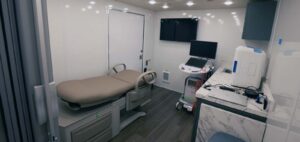
This is where the equipment decision becomes a funding decision. A unit built for one narrow service is a unit that gets mothballed when that funding stream ends. A unit that can flex between preventive and wellness services, community outreach, and remote and specialty care as grant priorities rotate is one you can keep funded across cycles.
Practically: modular interiors, adequate power and connectivity headroom, telehealth-ready infrastructure, and layouts that don’t hard-code a single workflow. The incremental cost at build time is small. The cost of not having it is a five-year asset that matches a two-year grant.
5. Treat build lead time as part of the funding math
States have moved from planning into execution, finalizing governance structures, confirming partners, and translating proposals into operational workplans. Organizations that align early to awarded priorities and implementation timelines are best positioned.
Procurement cycles are active and year-two allocations are ahead. Build lead times are real. If your plan is to apply for funding first and then figure out the unit, you may find the money has an expiration date your delivery schedule can’t meet. Get quotes and timelines in hand before you submit, so your application can name a specific in-service date.
The honest summary
The coverage side is getting harder and there’s no version of 2026 where that isn’t true. But the infrastructure side has more money in it than it has had in a generation, and it is explicitly pointed at flexible, community-based care delivery.
The programs that come out of this stronger will be the ones that stop framing mobile care as a service line to be reimbursed and start framing it as infrastructure that reduces total cost of care. That’s the argument both your hospital partners and your state administrators are looking for right now.
Frequently Asked Questions
What is the Rural Health Transformation Program and can it fund a mobile clinic?
The RHTP is a $50 billion federal program distributing $10 billion annually to states from fiscal years 2026 through 2030. All 50 states received first-year awards averaging $200 million. States decide how to allocate their funds, and many named EMS and mobile care innovation, primary care access, and technology modernization among their priorities — which means mobile clinic projects are eligible in many states. Check your state’s approved plan and the administering agency to confirm.
How will 2026 Medicaid changes affect my mobile clinic’s revenue?
The most immediate effect is a payer mix shift rather than a rate change. New work-reporting requirements and six-month redeterminations are projected to move millions of people off Medicaid, many for documentation reasons rather than actual ineligibility. Those patients still need care, so programs should expect a higher uninsured share of encounters and plan revenue accordingly.
What’s the strongest financial argument for a mobile clinic right now?
Cost avoidance. Emergency department visits prevented, admissions avoided, and conditions caught at an earlier, cheaper stage are numbers hospital CFOs and state administrators already track. As coverage contracts and uncompensated care rises, an upstream intervention that reduces total cost of care is a more durable argument than one based on billable encounter volume.
Should I apply for funding before or after I order the unit?
Neither, exactly — get pricing and a build timeline before you apply, then order once funding is confirmed. Custom mobile clinic builds typically run 12 to 24 weeks depending on scope, and grant windows often carry spend-by dates. An application that names a specific in-service date is stronger than one that doesn’t, and it protects you from winning money you can’t deploy in time.
How do I keep a mobile clinic funded when grant priorities change?
Build for flexibility. A unit configured for one narrow service becomes hard to fund when that program ends. Modular interiors, telehealth-ready infrastructure, and adequate power and connectivity headroom let the same asset serve primary care this year and behavioral health or screening next year, which lets you follow funding across cycles instead of being stranded by it.
Building an RHTP application or a board case?
Talk to our team about scoping a build and timeline that fits your funding window — or see our FAQ for typical build times, ADA compliance, and power and connectivity options.